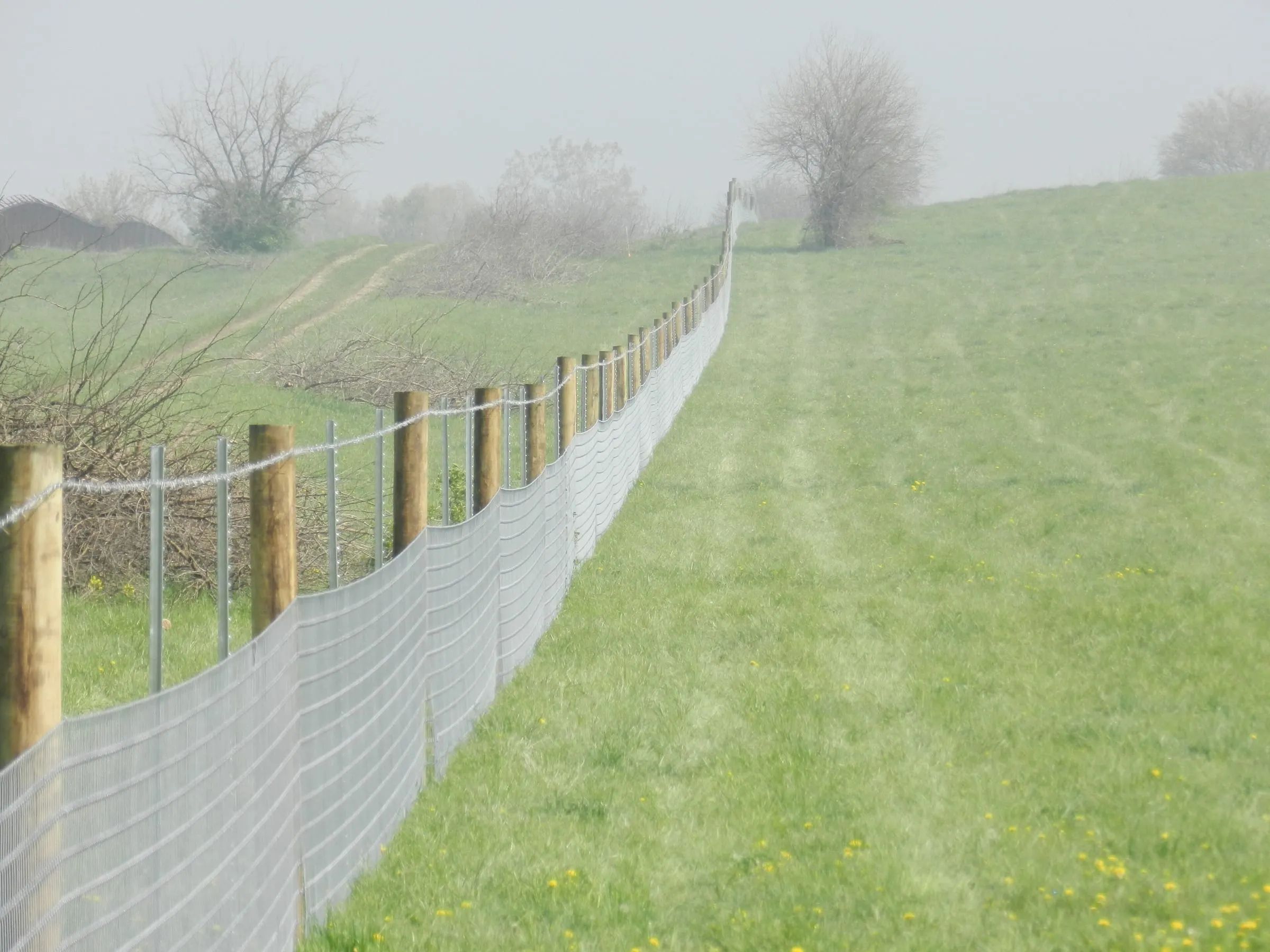
What do you need to measure a yard?
A long tape or a measuring wheel, stakes or small flags, string, paper and your plat or survey if you have one. A second person to hold the end of the tape makes it quicker.
Measure in feet and round each run up to the next foot. A rough sketch with every length written on it is worth more than a neat drawing without numbers. Draw the house, the drive, trees, sheds and anything else near the line.
Where exactly is your property line?
Look for the iron pins at your corners, using your plat or survey as a guide. If you can’t find them, or the line is in doubt, have a surveyor find or reset them before you go further.
National cost guides put a boundary survey at roughly $200 to $1,000. Once you know the line, decide how close to it the fence will sit. Oconee County lets a fence stand in a setback as long as it stays on your property, and the City of Clemson keeps fences at least 18 in from a street right-of-way. Building a fence on the property line covers pins, neighbors and lake lines, and fence permits and rules, town by town covers corner sight lines and the rest of the local rules.
How do you mark the corners?
Drive a stake at every corner and end, and at each side of every gate, then stretch string between them. The string is your fence line, so walk it and look for trouble before you measure.
Check that the string clears trees, sheds, the AC unit and the septic area, and that it leaves room to mow along it. Where the fence ties into the house, set the stake right at the wall, where the last post will stand. Keep stakes clear of any utility flags; when the job goes ahead, we file the SC811 locate before anything is dug.
How do you measure each run?
Measure each straight stretch on its own, along the ground, from stake to stake. Write each length on your sketch, then add them up for the total.
A run ends wherever the line turns. Keep the tape tight and on the string, not cutting across a corner. On a long run, measure in sections and add them. A measuring wheel is quicker on a big lot but less exact in tall or rough grass, so check one run with a tape.
Do gate openings count?
Yes. Measure straight through each gate opening as if it were fence, then list the gates separately as walk gates or drive gates.
A walk gate is for people, a wheelbarrow and a push mower. A drive gate, usually a double gate, is for a truck, a trailer, a riding mower or a tractor. Note the width you want for each and which way it should swing.
What else should you write down?
Anything that changes how the fence is built: slope, rock, big roots, trees on the line, ditches and how close a truck can get. Also note an old fence that has to come out first.
- Slope. Mark where the ground drops and roughly how much. Cost guides add about 10 to 50 percent, depending on how steep it is.
- Rock, red clay and roots. Upstate Cecil soils have a red clay subsoil, and rock, hard clay and roots slow the digging.
- Access. A narrow side yard or a steep bank between the street and the line means materials are carried in by hand.
- An old fence. Taking it down and hauling it away runs $3–5 a foot.
What does a worked example look like?
Take a lot 70 ft wide with a house 40 ft wide. The fence leaves each back corner of the house, runs to the side lines, goes back 45 ft and crosses the rear line: 190 ft in all.
| Run | From and to | Length |
|---|---|---|
| A | Left back corner of the house to the left side line | 15 ft |
| B | Down the left side line to the rear corner | 45 ft |
| C | Along the rear line | 70 ft |
| D | Up the right side line | 45 ft |
| E | Right side line to the right back corner of the house | 15 ft |
| Total | 190 ft |
The house wall closes the fourth side, and one walk gate goes in run A. That is a typical size: most back yards here run 150 to 200 ft. As a 6 ft wood privacy fence with one walk gate, the estimator puts it at $4,500–$7,000.
How far apart do the posts go?
About 8 ft for wood and board fence, 6 ft for aluminum and vinyl panels, and 10 ft for chain link and field fence. Those are the spacings our estimator uses.
To count posts, take each straight run on its own. Divide its length by the spacing, round up to get the sections, and add one for the posts. Runs that meet at a corner share that post. The example above, in wood:
- Run A, 15 ft: 2 sections, 3 posts
- Run B, 45 ft: 6 sections, 7 posts
- Run C, 70 ft: 9 sections, 10 posts
- Run D, 45 ft: 6 sections, 7 posts
- Run E, 15 ft: 2 sections, 3 posts
That is 30 posts, less 4 shared corners, so about 26. A gate usually adds a post or two, since its posts have to sit exactly a gate’s width apart. We set posts for wood, vinyl and aluminum in concrete. Long runs of field and board fence follow the same math at their own spacing.
How do you turn the numbers into a price?
Enter the total length, the fence type and the number of walk and drive gates in the fence estimator. Tick the boxes for an old fence or a sloped, rocky line, and it gives you a ballpark range.
What a fence costs in Seneca shows the per-foot prices behind that range and what moves a job up or down. You can send the details from the same page. Before the layout is final, we check the town, county, HOA and lake rules that apply to your lot.